A partner’s guide to timing contractions
If you are the partner, friend or relative on hand, the log is a job you can take off the other person’s plate. Here is how to do it well, and what the main sources say a support person can do besides.

Timing is one of the jobs March of Dimes names when it describes what a labor support person can learn: timing contractions, helping the person in labor relax, and helping them move around to find a comfortable position. Cleveland Clinic says a labor support person is very helpful and that it could be a significant other, a family member, a friend or a doula. You do not need any training to keep a good log. You need a phone, a signal you have agreed on, and a little restraint.
Before the day: three things to settle together
- What the provider wants. ACOG suggests talking with the care team, well before the due date, about the right time to call, how to reach them after office hours, whether to call first or go straight to the hospital, and any special steps to take if labor begins. If you can, be at that appointment, or ask for the answers to be written down. Save the after-hours number in your phone as well as theirs.
- The trip. ACOG also suggests working out how long the journey takes, rehearsing it, and allowing for traffic, rush hour and delays on the usual route. It suggests packing the hospital bag and leaving it somewhere handy, such as a hall closet or the trunk of the car, and making sure the car seat is properly installed.
- Who covers what at home. Other children, pets and the house all need a plan, ACOG notes. Make the calls now, not at 3 a.m.
How to time without getting in the way
You cannot feel a contraction from the outside with any precision, so you rely on the person having it. Mayo Clinic says that as labor contractions get stronger it becomes hard to talk during them, and March of Dimes says they can get so strong that walking and talking are impossible. So do not make the person in labor explain anything mid-contraction. Agree on a signal beforehand: a word such as “now” at the start and “done” at the end, a raised hand, a squeeze of your arm.
- Open the contraction timer on your phone and leave it on the screen.
- Tap Start at the first signal. Tap Stop at the second.
- If you missed the start by a few seconds, carry on and fix it later with Edit. If you missed one entirely, leave it out. A gap is more honest than a guess.
- When the contraction has passed, you can ask how it felt and tap Mild, Moderate or Strong. Or skip it. The strength note is optional for a reason.
The Apart figure is measured from the start of one contraction to the start of the next, which is how Mayo Clinic and Cleveland Clinic describe timing. You do not need to do any sums; the timer does them. If you are keeping the log on paper, see how to time contractions for the four columns to draw.
What to note besides the times
The person on the phone will ask about more than contractions. Jot down, with the clock time:
- anything that changed them: a walk, lying down, a glass of water, a bath. ACOG and March of Dimes both suggest noting whether contractions carry on through rest, water or moving around;
- whether the water has broken, when, and what it looked like;
- any bleeding;
- whether the baby is moving as usual.
What to note down for your provider has a short script you can fill in and read out, so the person in labor does not have to make the call.
What else a support person can do
The sources list several comfort measures for the early, at-home part of labor. The NHS suggests that a birth partner can rub the person’s back to help relieve pain, and can do relaxation and breathing exercises with them as contractions get stronger. Cleveland Clinic suggests a partner or friend massaging the back and shoulders, a warm bath or shower, slow deep breathing, swaying or rocking the pelvis, an ice pack on the lower back, and distraction with a movie or music. The NHS also mentions drinks and a snack if the person in labor feels like one.
A few practical things the sources imply, even if they do not spell them out:
- Follow their lead. Comfort measures are offers, not a program. If a back rub is unwelcome in this contraction, it may be welcome in the next.
- Keep the room calm at night. The NHS says that if labor starts at night, the person in labor should try to stay comfortable and relaxed, and sleep if they can. Dim the lights, keep your phone’s brightness low, and let them rest between contractions.
- Look after yourself too. Early labor can take many hours, or even days, according to the NHS. Eat, drink water, and rest when you can. A partner who has not slept for 20 hours is less help at the end.
Sharing the log
The timer saves its log on the phone you are using, in that browser only. It is not sent anywhere and it does not sync to the other person’s phone. To pass it on, tap Copy log as text and paste it into a message, or use Share where the phone offers it. Sending a copy to yourselves every hour or so is a sensible backup if a battery is running low.
Signs that should not wait for the log
Your job is to keep the record, not to judge it. Still, it helps to know which signs the sources say need a call or a trip straight away, whatever the timer shows.
ACOG says to go to the hospital if the water has broken without contractions, there is heavy vaginal bleeding, there is constant, severe pain with no relief between contractions, or the baby is moving less often.
Cleveland Clinic’s Braxton Hicks page adds bright red bleeding, a gush or continuous leak of fluid, and contractions the person cannot walk or talk through.
The NHS tells people in the UK to call an ambulance if they think the baby is coming now and there is a strong urge to push. In the US, the emergency number is 911.
Before 37 weeks, ACOG says not to wait: call the ob-gyn’s office right away or go to the hospital.
If in doubt, make the call yourself. March of Dimes says to call your provider no matter what time of day or night, and Mayo Clinic says not to hesitate if you are confused about whether labor has started. If you go in and it turns out to be a false alarm, Mayo Clinic suggests thinking of it as a practice run.
This page is for the person keeping the log. It cannot tell either of you what the log means. Follow the instructions your own provider gave you, and call your provider or emergency services if you are worried.
Sources
- March of Dimes. Stages of labor (last reviewed March 2019). Opened November 21, 2026.
- Cleveland Clinic. Stages of Labor (last updated April 23, 2025). Opened November 21, 2026.
- ACOG (American College of Obstetricians and Gynecologists). How to Tell When Labor Begins (last reviewed November 2025). Opened November 21, 2026.
- Mayo Clinic. Signs of labor: Know what to expect (July 23, 2024). Opened November 21, 2026.
- NHS. Signs that labour has begun (page last reviewed 9 November 2023). Opened November 21, 2026.
- Cleveland Clinic. Contractions (last updated August 8, 2024). Opened November 21, 2026.
- NHS. The stages of labour and birth (page last reviewed 2 May 2023). Opened November 21, 2026.
- Cleveland Clinic. Braxton Hicks Contractions (last updated July 8, 2025). Opened November 21, 2026.
- ACOG (American College of Obstetricians and Gynecologists). Preterm Labor and Birth (last reviewed January 2026). Opened November 21, 2026.
- March of Dimes. Contractions and signs of labor (last reviewed December 2025). Opened November 21, 2026.
Read next
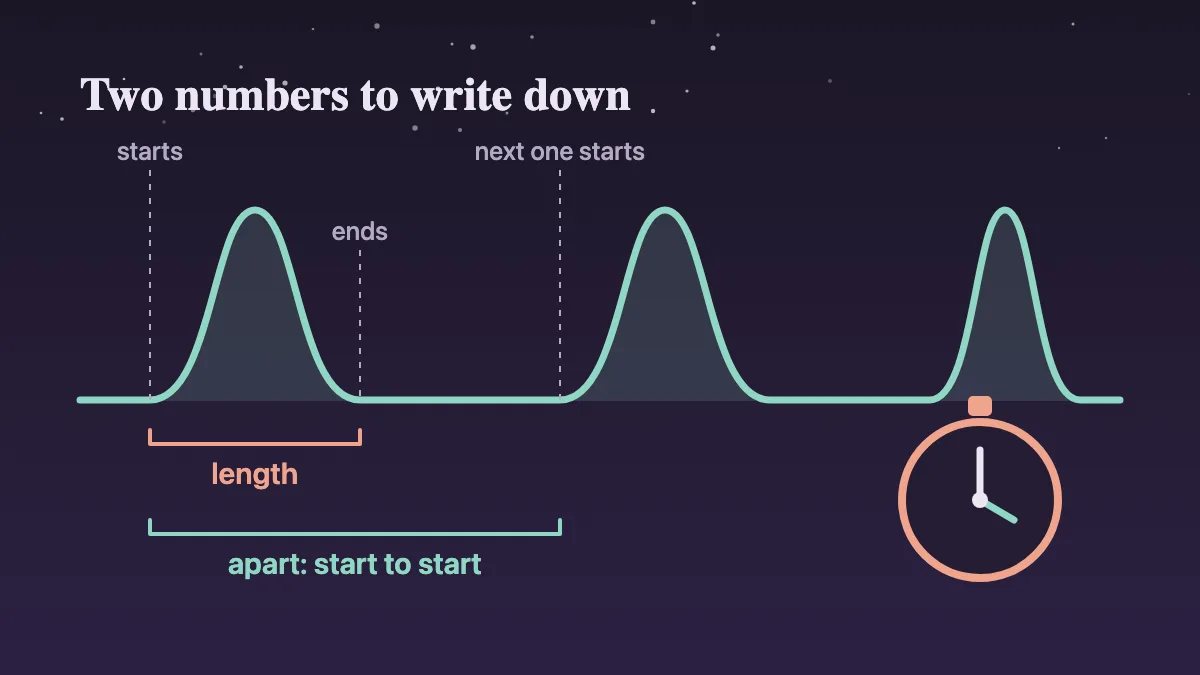
How to time contractions
The two numbers to write down, a worked example, and the mistakes that skew a log.
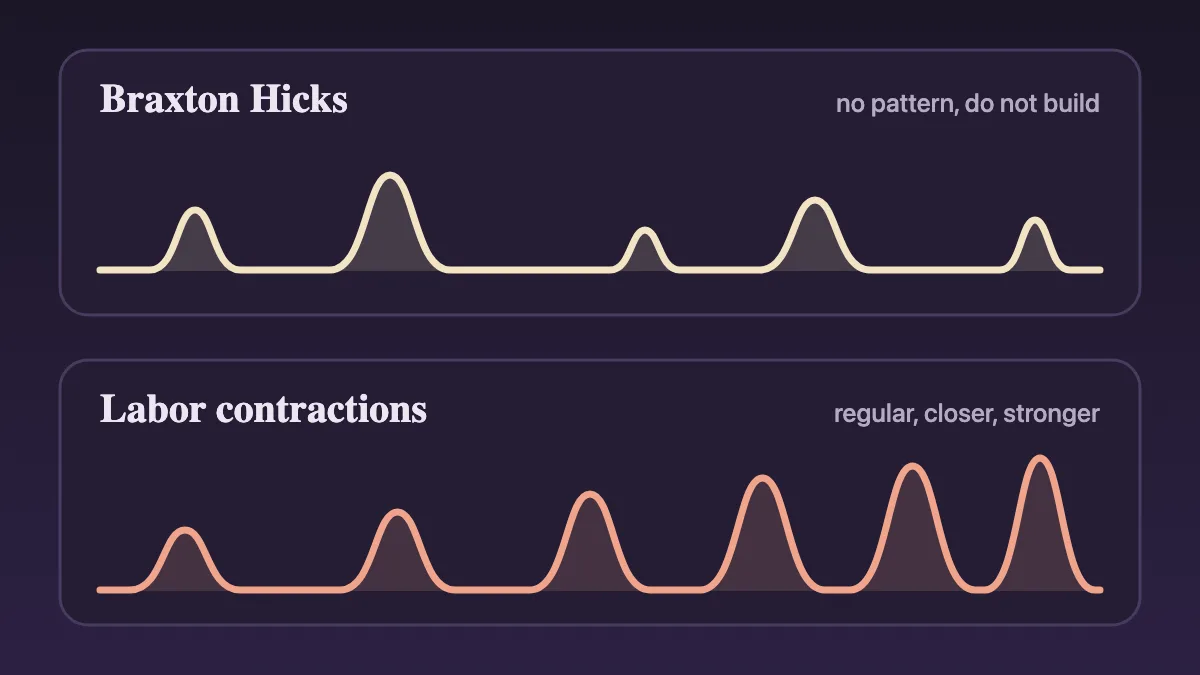
Braxton Hicks or labor contractions?
Five questions the main sources use to tell them apart, and the cases where a log cannot.
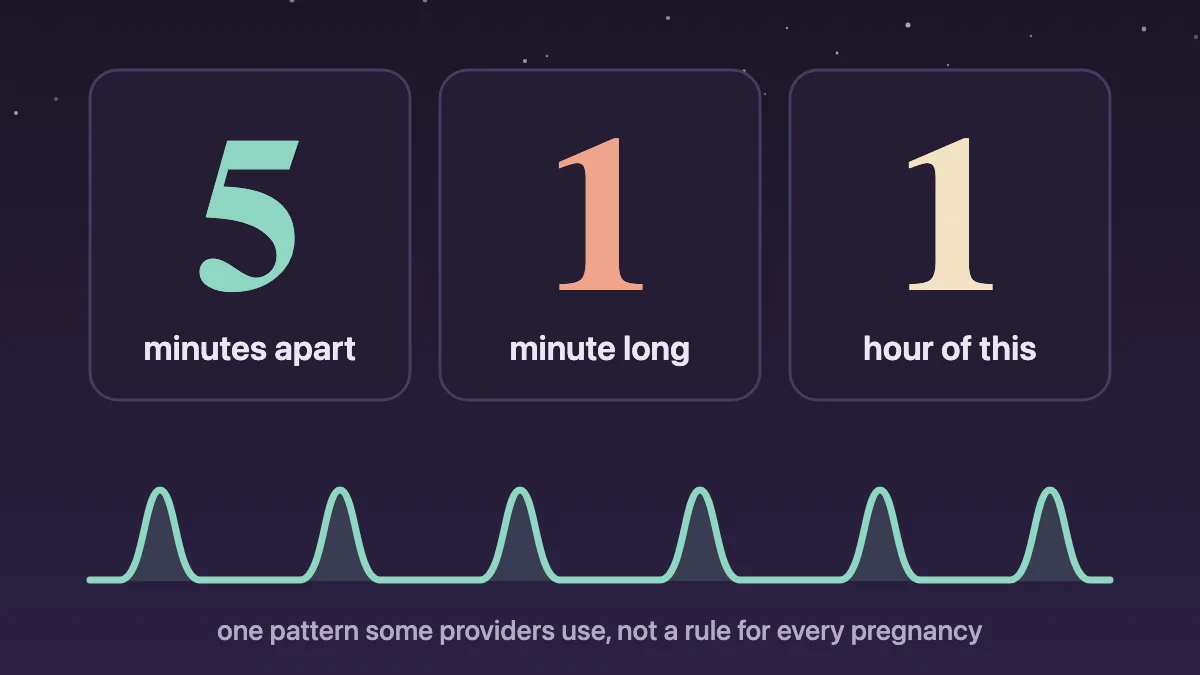
What the 5-1-1 pattern means, and its limits
Five minutes apart, one minute long, for one hour: what that is for, and what it leaves out.
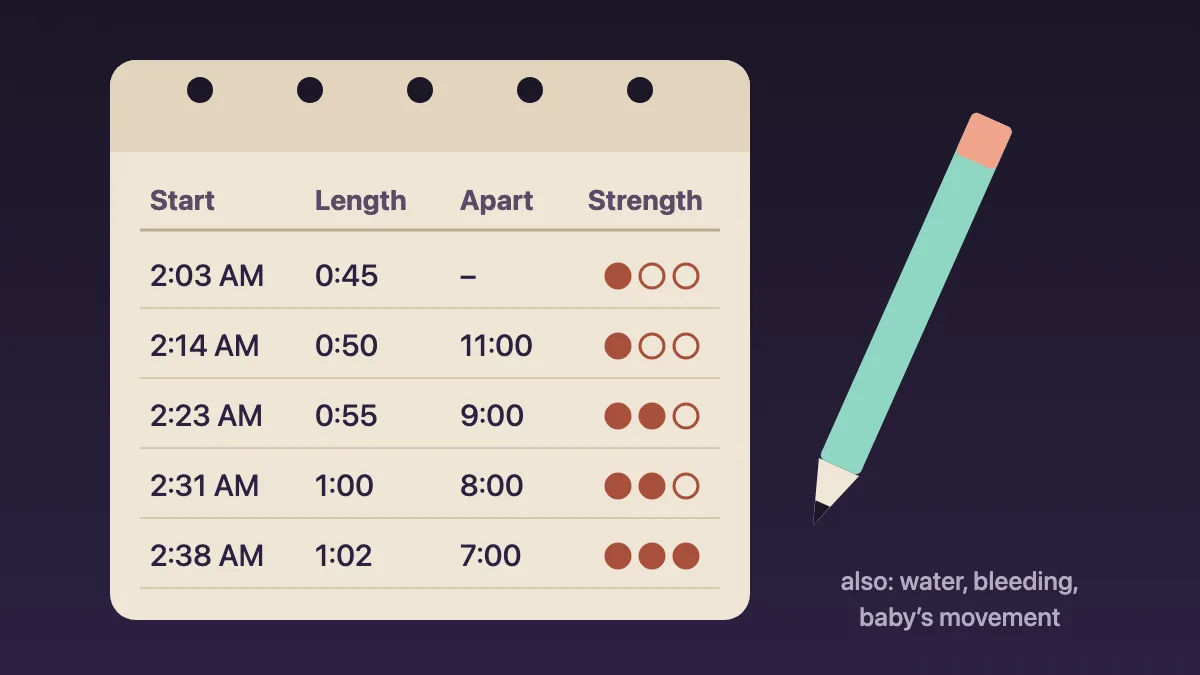
What to note down for your provider
The details a labor line usually asks for, and a short script to read from when you call.

Early labor at home, in the words of the sources
How long it lasts, what helps, and what each source says should prompt a call.