How to time contractions
You need two numbers: how long each contraction lasts, and how long it is from the start of one to the start of the next. Here is how to get both, with a phone or with pen and paper.
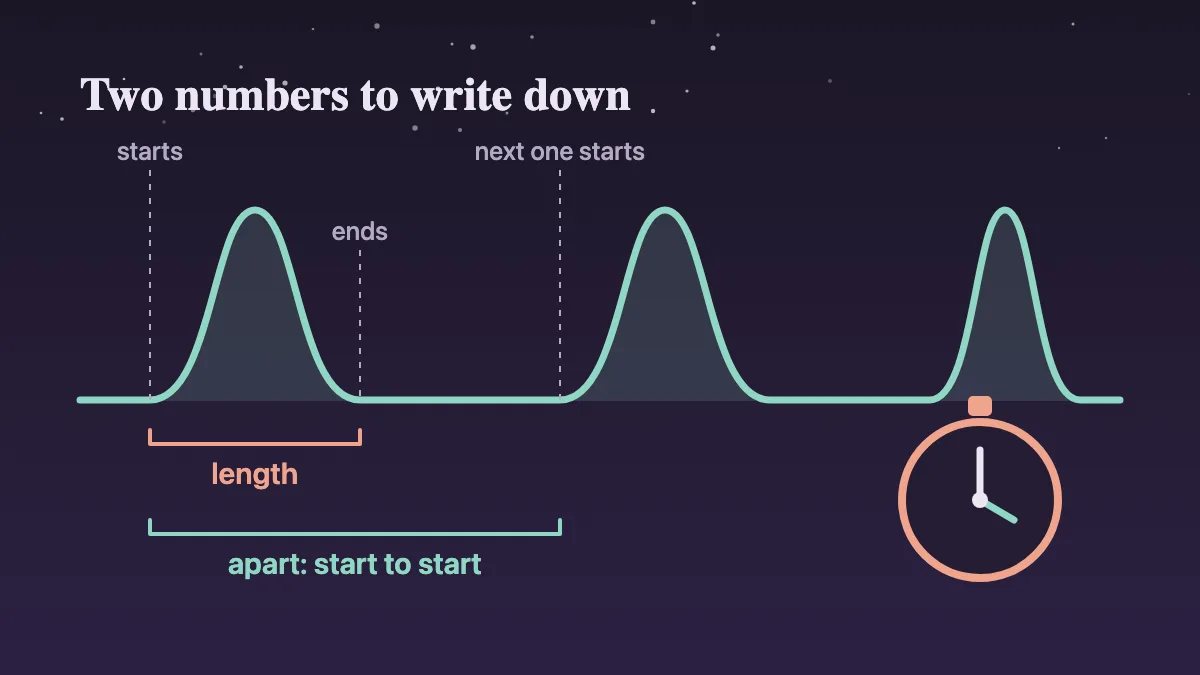
Timing contractions is the one piece of labor homework almost everyone is given. Cleveland Clinic says most healthcare providers will ask you to do it, because the pattern helps them see whether labor is starting. March of Dimes suggests starting when you first feel contractions, to help tell true labor from false labor. This page is about the mechanics: what to measure and how to keep a log someone else can read.
The two numbers
- Length (also called duration): from the moment a contraction starts to the moment the same contraction ends.
- Apart (also called frequency or interval): from the start of one contraction to the start of the next one.
The second one trips people up. It is tempting to measure the quiet stretch between contractions, but that is not what providers mean. Mayo Clinic puts it plainly: time from the beginning of one to the beginning of the next. Cleveland Clinic gives the same instruction and adds that it is easiest to work in seconds.
A worked example
| Starts | Ends | Length | Apart |
|---|---|---|---|
| 2:03:10 AM | 2:03:55 AM | 0:45 | – |
| 2:11:10 AM | 2:12:02 AM | 0:52 | 8:00 |
| 2:18:40 AM | 2:19:35 AM | 0:55 | 7:30 |
The second contraction started eight minutes after the first one started, so it is 8:00 apart. The third started seven and a half minutes after the second started. The first row has no Apart figure because nothing came before it.
Notice that the rest between contractions is shorter than the Apart figure. Between the second and third there were 6 minutes 38 seconds of rest (7:30 minus the 0:52 the contraction itself took). That is why “five minutes apart” feels like much less than five minutes of break.
Step by step
- Find the start. ACOG describes what is happening: when the uterus contracts the abdomen becomes hard, and between contractions it relaxes and becomes soft. The NHS suggests a hand on your abdomen: you will feel it getting harder, and feel the hardness ease as the muscles relax. Start is when the tightening begins to build, not when it peaks.
- Press Start on the contraction timer, or write down the clock time including seconds.
- Press Stop when it has eased, or write down that time too. Stopping at the peak makes every contraction look shorter than it was.
- Repeat for several in a row. One contraction tells you nothing about a pattern. From the second one on, you get an Apart figure as well.
- Add a word about strength and what you were doing. ACOG suggests noting whether the contractions continue when you are resting and drinking water, and March of Dimes adds how strong they feel and whether they keep going when you move around.
Doing it on paper works just as well. Draw four columns like the table above, keep a clock with a seconds display in view, and subtract start times to get Apart.
How long to keep timing
You do not have to time every contraction from the first twinge to the hospital door. Cleveland Clinic’s Braxton Hicks page suggests about an hour of start-to-start timing when you are trying to work out what you are feeling. After that you have a picture you can describe.
The early part of labor can be long. The NHS says it can take many hours, or even days, before labor is established, and Mayo Clinic says early labor may stop and start. Timing a run of contractions every so often, then putting the phone down, leaves room for the rest the NHS recommends: if labor starts at night, stay comfortable and sleep if you can. Our page on early labor at home sets out what each source says about that phase.
What a pattern can look like
The sources describe labor contractions in slightly different numbers, which is worth knowing before you compare your log with any one of them:
- ACOG: true labor contractions come at regular intervals, get closer together over time, and each lasts about 60 to 90 seconds.
- Mayo Clinic: labor contractions are generally 2 to 5 minutes apart and last about 60 to 90 seconds.
- March of Dimes: in early labor, mild contractions may come every 5 to 15 minutes and last 60 to 90 seconds.
- Cleveland Clinic: in active labor, contractions may last 40 to 70 seconds and come every three to five minutes.
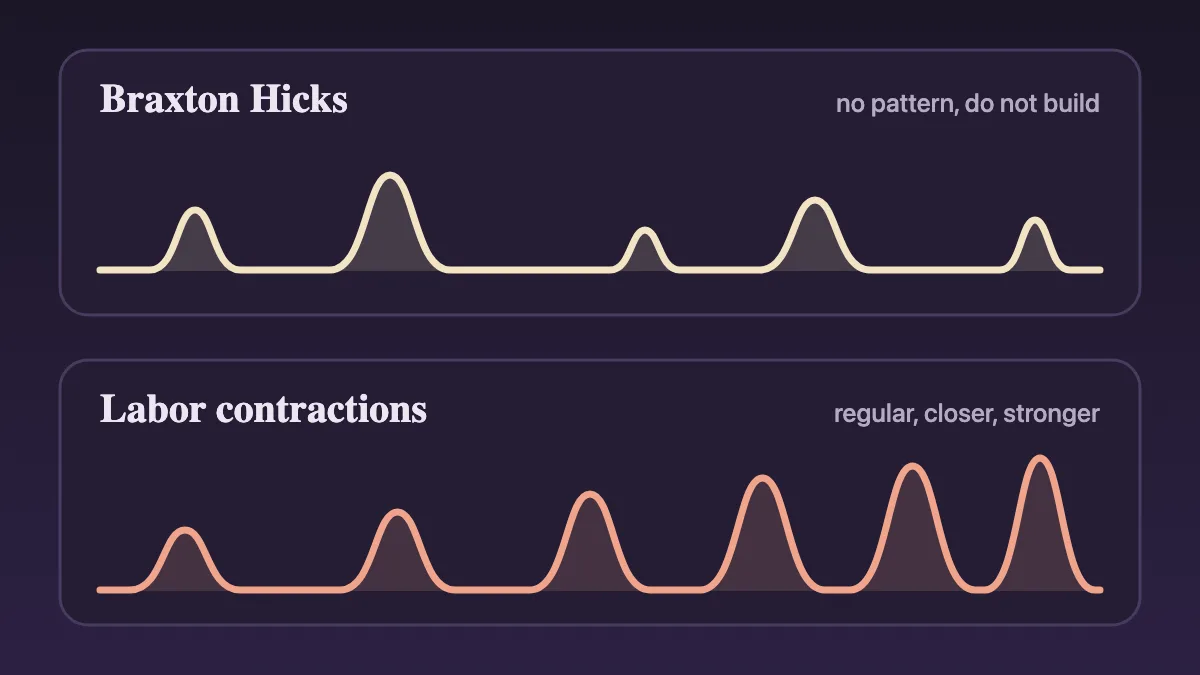
What they agree on is the direction. In the NHS’s words, contractions tend to become longer, stronger and more frequent
as labor progresses. A log shows direction better than memory does: read down the Apart column and see whether the gaps are shrinking, holding or wandering. The difference between a wandering pattern and a tightening one is the subject of Braxton Hicks or labor contractions.
Mistakes that skew a log
- Measuring Apart from the end of one contraction. That gives the rest time and makes contractions look further apart than a provider would count them.
- Mixing old and new. An average that includes this morning’s scattered tightenings says little about the last hour. The timer’s averages only use contractions that started in the past 60 minutes.
- Guessing a missed Stop. If you forgot to stop the clock, correct the row to your best estimate or delete it. One missing row matters less than one wrong one.
- Timing instead of resting. A log is a means, not the goal. If watching the clock is winding you up, hand the phone to your partner. There is a partner’s guide for exactly that.
When timing is not the point
A log is for describing a pattern. It is not a reason to wait. ACOG lists four signs for going to the hospital whatever the clock says: your water has broken and you are not having contractions, heavy bleeding from the vagina, constant severe pain with no relief between contractions, and the baby moving less often. The NHS adds contractions that last longer than two minutes, six or more contractions in ten minutes, and any thought that you might be in labor before 37 weeks.
This page explains how to keep a record. It cannot tell you what your record means for you. Follow the instructions your own provider gave you, and call your provider or emergency services if you are worried.
Sources
- Cleveland Clinic. Contractions (last updated August 8, 2024). Opened November 21, 2026.
- March of Dimes. Contractions and signs of labor (last reviewed December 2025). Opened November 21, 2026.
- Mayo Clinic. Signs of labor: Know what to expect (July 23, 2024). Opened November 21, 2026.
- ACOG (American College of Obstetricians and Gynecologists). How to Tell When Labor Begins (last reviewed November 2025). Opened November 21, 2026.
- NHS. Signs that labour has begun (page last reviewed 9 November 2023). Opened November 21, 2026.
- Cleveland Clinic. Braxton Hicks Contractions (last updated July 8, 2025). Opened November 21, 2026.
- NHS. The stages of labour and birth (page last reviewed 2 May 2023). Opened November 21, 2026.
- Mayo Clinic. Stages of labor and birth: Baby, it’s time! (July 23, 2024). Opened November 21, 2026.
- March of Dimes. Stages of labor (last reviewed March 2019). Opened November 21, 2026.
Read next
Braxton Hicks or labor contractions?
Five questions the main sources use to tell them apart, and the cases where a log cannot.
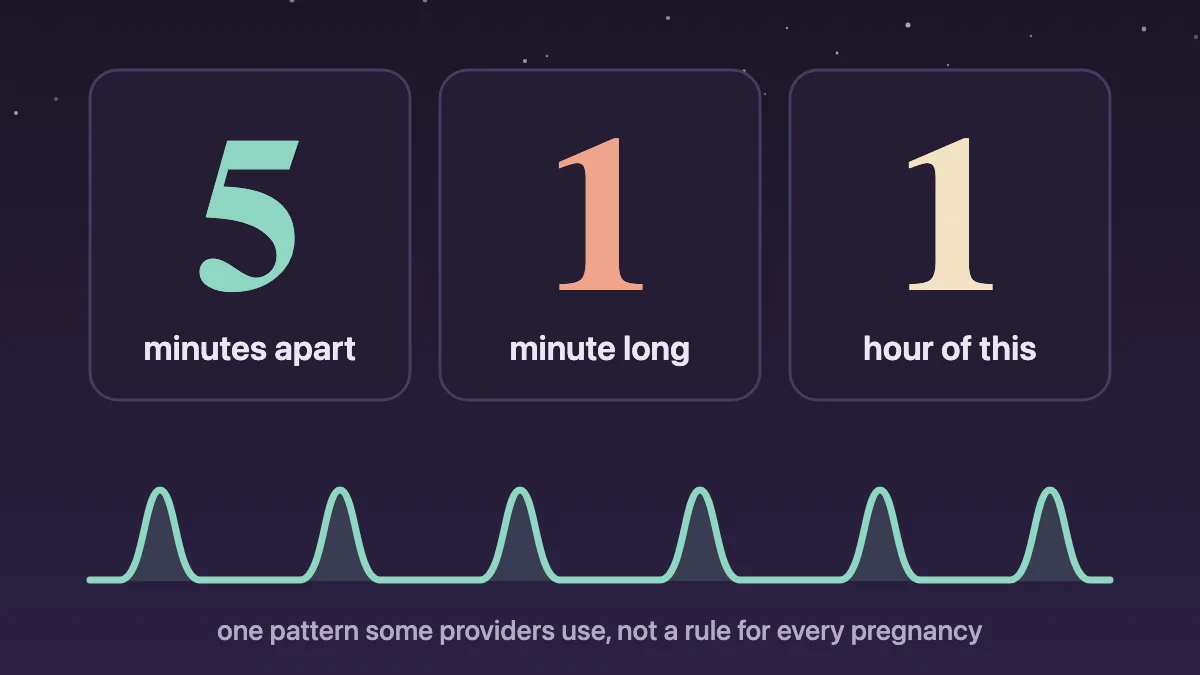
What the 5-1-1 pattern means, and its limits
Five minutes apart, one minute long, for one hour: what that is for, and what it leaves out.
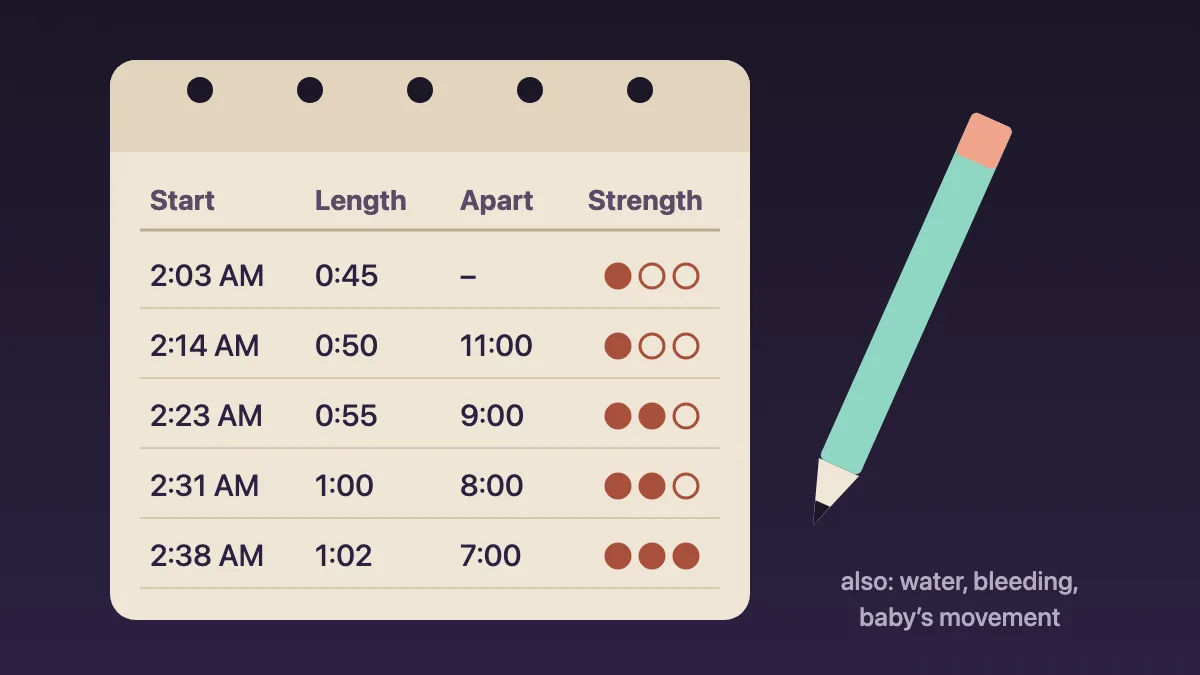
What to note down for your provider
The details a labor line usually asks for, and a short script to read from when you call.

A partner’s guide to timing contractions
How to keep the log so the person in labor does not have to, and what else to have ready.
Early labor at home, in the words of the sources
How long it lasts, what helps, and what each source says should prompt a call.