Contraction Timer
Tap Start when a contraction begins
- In the last hour
- 0
- Average length
- –
- Average apart
- –
Your log
| # | Start | Length | Apart | Strength | Edit |
|---|
Nothing recorded yet. Each contraction you time appears here with its start time, its length, and how long after the previous one it started.
Apart is measured from the start of one contraction to the start of the next. Newest first.
A record-keeping tool, not a medical device. It cannot tell whether you are in labor or when to leave home. Follow the instructions your own provider gave you, and call your provider or emergency services if you are worried. In the US, the emergency number is 911.
Tap Start when a contraction begins and Stop when it ends. The timer keeps the length of each one, how far apart they start, and averages for the last hour, all on this phone.
How to use the contraction timer
- Tap Start the moment a contraction begins, as you feel the tightening build. The clock counts up and the button changes to Stop.
- Tap Stop when it eases off. The contraction is added to your log with its start time and its length.
- Do the same for the next one. From the second contraction on, the log also shows how long after the previous one it started.
- Add a strength if you want to. Mild, Moderate and Strong are a quick note of how it felt to you. Tap the same one again to remove it.
Tapped by mistake? While the clock is running, Discard this one throws that timing away. Afterwards, Edit on any row lets you correct the start time, the length or the strength, or delete the row.
What the numbers mean
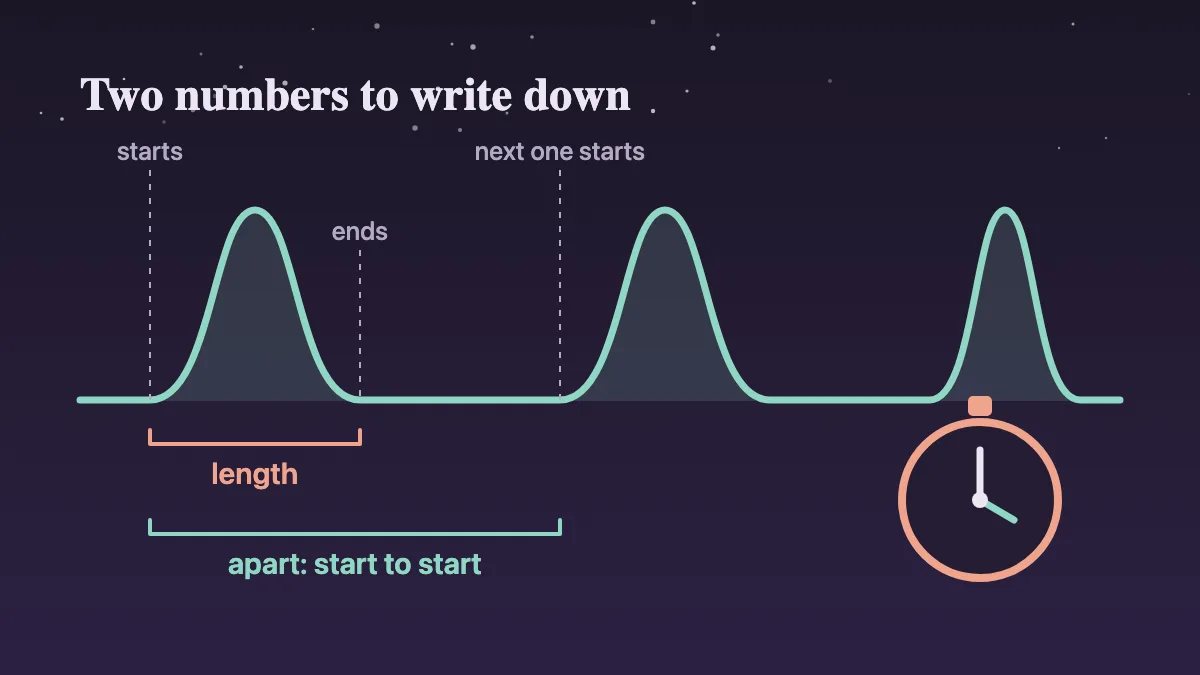
- Length is the time from the start of a contraction to the end of the same contraction.
- Apart is the time from the start of one contraction to the start of the next. It is not the rest between them. This start-to-start measure is the one Mayo Clinic and Cleveland Clinic describe when they explain timing.
- In the last hour counts the contractions that started in the past 60 minutes, with their average length and average time apart. Older rows stay in the log but drop out of these averages.
Between contractions the big clock shows the time since the last one started, so you can watch the gap without doing sums. There is more detail, with a worked example, in how to time contractions.
What to do with the numbers
The timer records. It does not decide anything, and it will never announce that it is time to leave. What a pattern means for you depends on your pregnancy, your history and how far you are from where you plan to give birth. That is why ACOG suggests settling with your care team, well before the due date, the right time to call and whether to call first or go straight in.
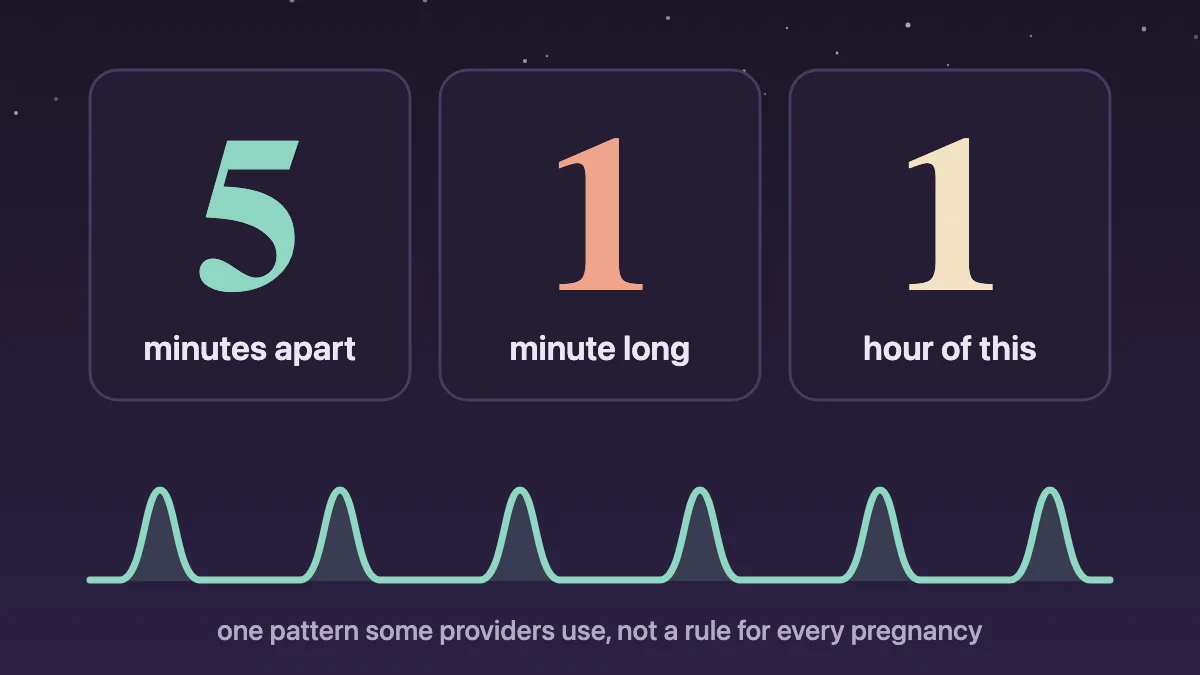
One pattern you may have heard of is 5-1-1. Cleveland Clinic describes it as contractions five minutes apart, lasting one minute each, for about an hour, and adds that your own team may give you other instructions. Our guide to the 5-1-1 pattern covers where it helps and where it falls short.
Some signs do not wait for any pattern. ACOG lists these as reasons to go to the hospital: your water has broken and you are not having contractions, you are bleeding heavily, you have constant, severe pain with no relief between contractions, or you notice the baby moving less often. Mayo Clinic says to contact your care team right away if you have signs of labor before 37 weeks.
Follow the instructions your own provider gave you, and call your provider or emergency services if you are worried.
Your log stays on this phone
Everything you record is saved in this browser’s own storage on this device. Nothing is sent to us or to anyone else: this site has no accounts, no cookies and no tracking scripts. That also means the log does not follow you to another phone, and clearing your browser data erases it. To pass it on, tap Copy log as text and paste it into a message to your partner, doula or provider. What to note down for your provider lists what else they are likely to ask.
After your first visit the timer works without a connection, so a weak signal in a parking garage will not stop it. While a contraction is being timed, the page asks your phone to keep the screen awake. Tick Keep the screen on if you want it awake between contractions too. Not every browser supports this, so check your screen timeout if the display keeps dimming.
Questions people ask
Do I need to install an app?
No. The timer is a web page. Open contractiontimer.us in the browser on any phone, tablet or computer. On most phones you can also add it to your home screen from the browser menu, and it still works offline.
How is the time between contractions measured?
From the start of one contraction to the start of the next, which is how Mayo Clinic and Cleveland Clinic describe timing. So the Apart figure includes the contraction itself, not only the rest after it.
How long should I keep timing?
There is no fixed answer, so ask your provider what they want from you. Cleveland Clinic’s page on Braxton Hicks suggests noting start-to-start times for about an hour when you are trying to tell practice contractions from labor.
Can the timer tell me if I am in labor?
No. It only records what you tap. ACOG notes that sometimes the only way to tell true labor from false labor is an exam that looks for changes in the cervix. If you think you may be in labor, or you are not sure, call your provider.
I forgot to tap Stop. What now?
Tap Stop now. If more than 30 minutes have passed since Start, the row keeps its start time and shows the length as not known, so no made-up length goes into the log or the averages. Then tap Edit on that row to enter your best estimate, or delete the row.
Is it free?
Yes. There is nothing to buy and nothing to sign up for.
Sources
- Mayo Clinic. Signs of labor: Know what to expect (July 23, 2024). Opened November 21, 2026.
- Cleveland Clinic. Contractions (last updated August 8, 2024). Opened November 21, 2026.
- Cleveland Clinic Health Essentials. Baby on the Way? Here’s What You May Not Know About Labor and Delivery (June 6, 2024). Opened November 21, 2026.
- ACOG (American College of Obstetricians and Gynecologists). How to Tell When Labor Begins (last reviewed November 2025). Opened November 21, 2026.
- Cleveland Clinic. Braxton Hicks Contractions (last updated July 8, 2025). Opened November 21, 2026.
Guides
How to time contractions
The two numbers to write down, a worked example, and the mistakes that skew a log.
Braxton Hicks or labor contractions?
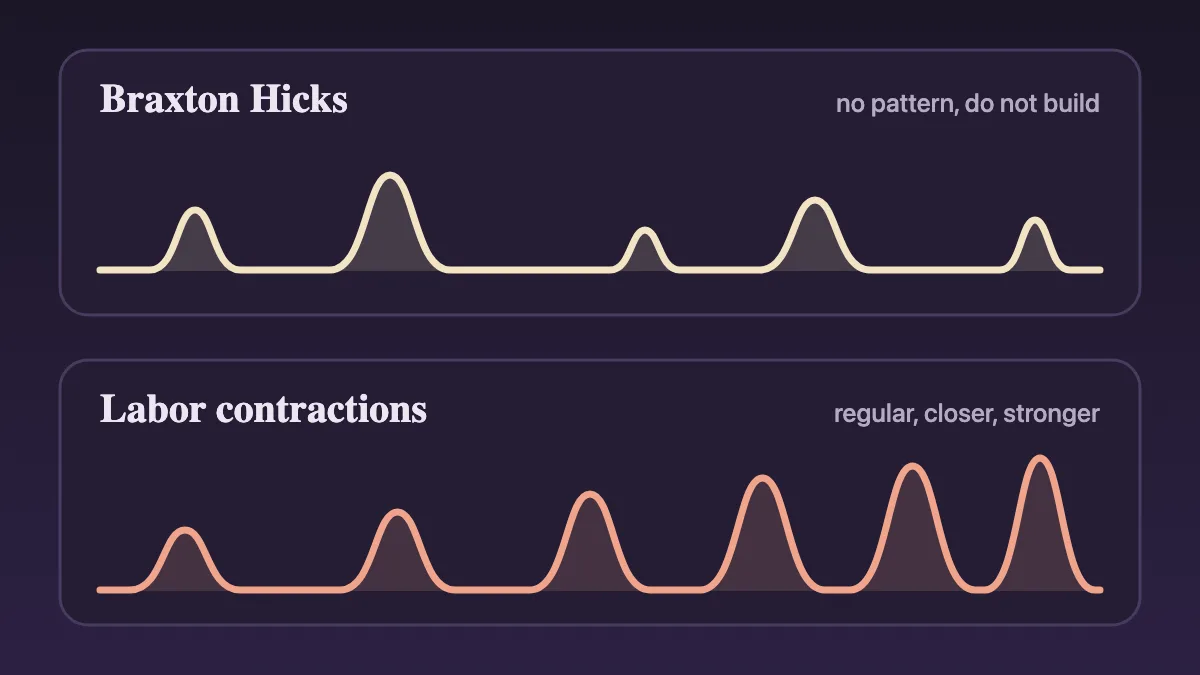
Five questions the main sources use to tell them apart, and the cases where a log cannot.
What the 5-1-1 pattern means, and its limits
Five minutes apart, one minute long, for one hour: what that is for, and what it leaves out.
What to note down for your provider
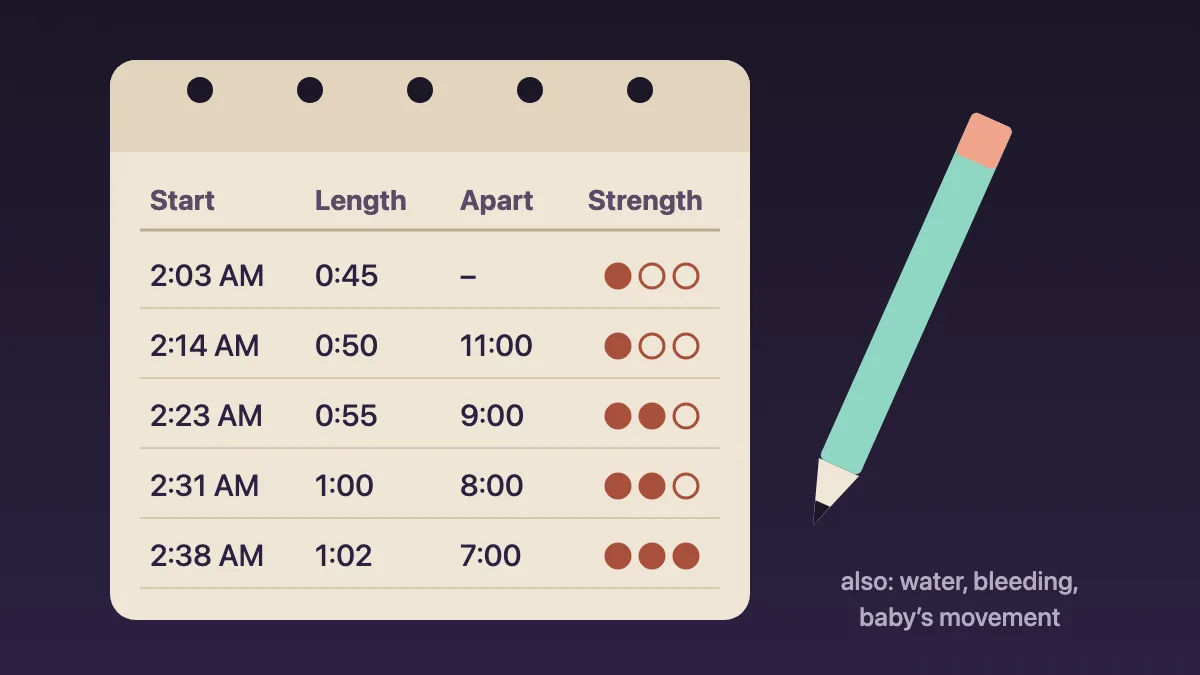
The details a labor line usually asks for, and a short script to read from when you call.
A partner’s guide to timing contractions
How to keep the log so the person in labor does not have to, and what else to have ready.
Early labor at home, in the words of the sources
How long it lasts, what helps, and what each source says should prompt a call.