Braxton Hicks or labor contractions?
Both are the uterus tightening. The difference shows up over time: one settles into a pattern and builds, the other does not. That is something a timer can help you see.
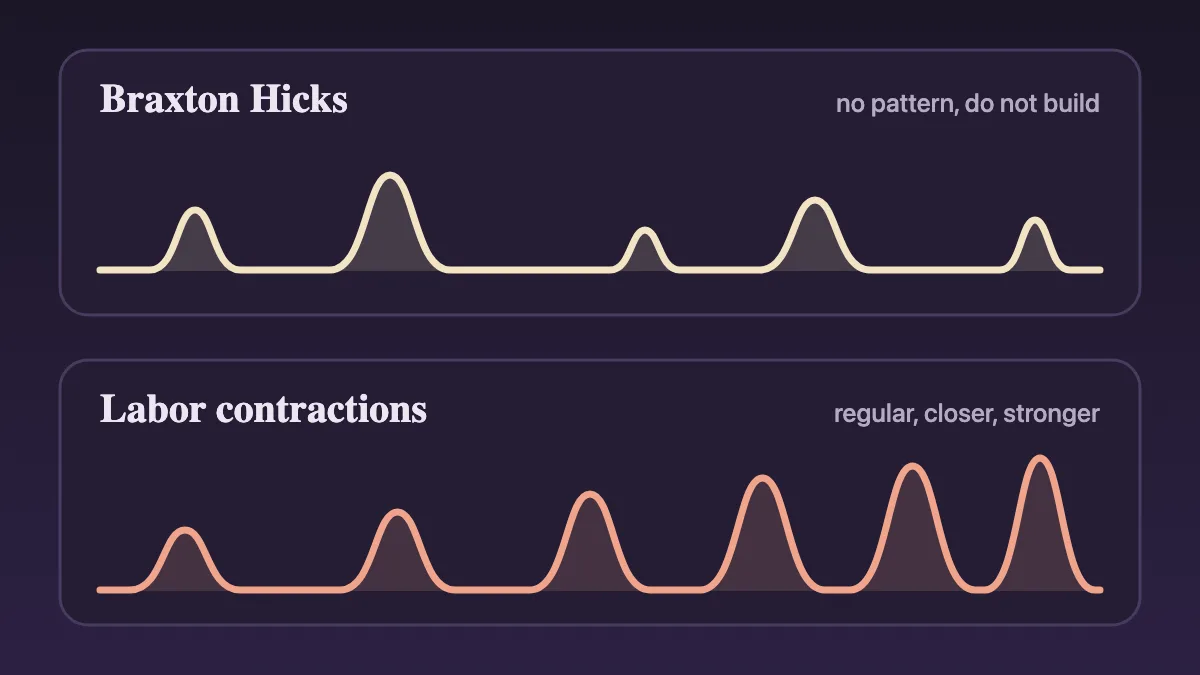
A single contraction cannot tell you which kind it is. What separates practice contractions from labor is how a run of them behaves over an hour or so, and that is why every source below tells you to time them. Here is what they say to look for, and where the comparison stops working.
What Braxton Hicks contractions are
ACOG calls them practice contractions that can happen for many weeks before real labor begins, and says you might notice them more at the end of the day. Cleveland Clinic says they can begin in the second or third trimester and may feel like mild menstrual cramps or random tightness in the abdomen. It lists things that may set them off: being dehydrated, being very active, a full bladder, sex, or lifting something heavy.
The sources do not agree on how much they hurt. The NHS describes them as uncomfortable but usually painless. ACOG says they can be very painful and can make you think you are in labor when you are not. So pain on its own is a poor guide. The pattern is a better one.
Five questions to ask
ACOG and Mayo Clinic both set the comparison out as a short list of questions. Put together, they look like this:
| Question | Braxton Hicks | Labor contractions |
|---|---|---|
| Is there a pattern? | No pattern, and they do not get closer together (ACOG). They may come and go (Mayo Clinic). | Regular intervals that get closer together over time (ACOG). |
| How long is each one? | Varying lengths (Cleveland Clinic). | About 60 to 90 seconds (ACOG, Mayo Clinic). |
| What happens if you rest, walk or change position? | They may stop (ACOG, Mayo Clinic). | They keep going whatever you do (ACOG, Mayo Clinic). |
| Are they getting stronger? | Usually weak, or strong at first and then weaker (ACOG, Mayo Clinic). | Steadily stronger (ACOG). It becomes hard to talk during one (Mayo Clinic). |
| Where do you feel it? | Usually only in the front (ACOG). | Usually starts in the back and moves to the front (ACOG). |
Cleveland Clinic adds a practical test of strength: with Braxton Hicks you should still be able to walk and talk through one.
What the two look like in a log
This is where a contraction timer earns its place. Time a run of contractions and read down the columns.
- A wandering log. Apart figures such as 12:00, 4:30, 19:00, 7:00, with lengths that jump around and strength notes that do not climb. That is what the left-hand column of the table describes.
- A tightening log. Apart figures such as 9:00, 8:00, 7:30, 6:30, with lengths creeping up towards a minute and strength moving from mild to moderate. That is the direction the right-hand column describes.
Cleveland Clinic suggests doing this for about an hour, writing down the start-to-start time and paying attention to how much pain you feel. If you are unsure how to measure, how to time contractions walks through it.
The rest and water check
ACOG gives one simple thing to try while you time: rest, drink water, and note whether the contractions continue. If rest and hydration make them go away, ACOG says, they are not true labor contractions. Cleveland Clinic’s list for easing Braxton Hicks runs along the same lines: take a walk if you have been sitting, lie down if you have been on your feet, drink water, have a snack, empty your bladder, or do something relaxing such as a bath.
It helps to write in your notes what you changed and when. A log that reads “lay down at 9:40, nothing after 9:55” tells your provider more than the numbers alone.
When a log cannot tell you
The comparison above is a guide, not a test, and all of the sources say so.
- A regular pattern is not proof of labor. Cleveland Clinic describes prodromal labor, a kind of false labor late in pregnancy in which contractions can come every five minutes and last a minute each, yet never advance beyond that. It says the only way to tell for sure is a check of the cervix.
- Labor is defined by the cervix, not the clock. In a Cleveland Clinic article, one of its ob-gyns explains that labor means painful, regular contractions together with a changing cervix, and that you cannot feel dilation or thinning for yourself.
- Sometimes only an exam settles it. ACOG and March of Dimes both say that sometimes the only way to tell true from false labor is for a provider to look for changes in the cervix.
So a log cannot rule labor in or out. What it can do is give the person on the other end of the phone a clear picture to work from.
Before 37 weeks, do not sort it out yourself
Everything above assumes you are at or near term. Earlier than that, the sources change their advice. March of Dimes lists regular or frequent contractions that make your belly tighten like a fist, painful or not, among the signs of preterm labor, and says to call your provider right away if you have even one sign. ACOG’s page on preterm labor says not to wait: call your ob-gyn’s office right away or go to the hospital. Mayo Clinic says the same about any signs of labor before 37 weeks. “Probably just Braxton Hicks” is not a call to make on your own before then.
When to call whatever the pattern
Cleveland Clinic’s Braxton Hicks page says to call your provider at any time if you have bright red vaginal bleeding, a gush or continuous leaking of fluid, strong contractions less than five minutes apart for an hour, contractions you cannot walk or talk through, or a noticeable change in your baby’s movement. ACOG’s advice is shorter still: if you think you are in labor, or are not sure, call.
And if you go in and are sent home, you have not wasted anyone’s time. Mayo Clinic’s advice for a false alarm is to think of it as a practice run.
This page compares descriptions from the sources listed below. It cannot tell you which kind of contraction you are having. Follow the instructions your own provider gave you, and call your provider or emergency services if you are worried.
Sources
- ACOG (American College of Obstetricians and Gynecologists). How to Tell When Labor Begins (last reviewed November 2025). Opened November 21, 2026.
- Cleveland Clinic. Braxton Hicks Contractions (last updated July 8, 2025). Opened November 21, 2026.
- NHS. Signs that labour has begun (page last reviewed 9 November 2023). Opened November 21, 2026.
- Mayo Clinic. Signs of labor: Know what to expect (July 23, 2024). Opened November 21, 2026.
- Cleveland Clinic. Prodromal Labor (last updated February 6, 2026). Opened November 21, 2026.
- Cleveland Clinic Health Essentials. Baby on the Way? Here’s What You May Not Know About Labor and Delivery (June 6, 2024). Opened November 21, 2026.
- March of Dimes. Contractions and signs of labor (last reviewed December 2025). Opened November 21, 2026.
- March of Dimes. Signs and symptoms of preterm labor (last reviewed December 2020). Opened November 21, 2026.
- ACOG (American College of Obstetricians and Gynecologists). Preterm Labor and Birth (last reviewed January 2026). Opened November 21, 2026.
Read next
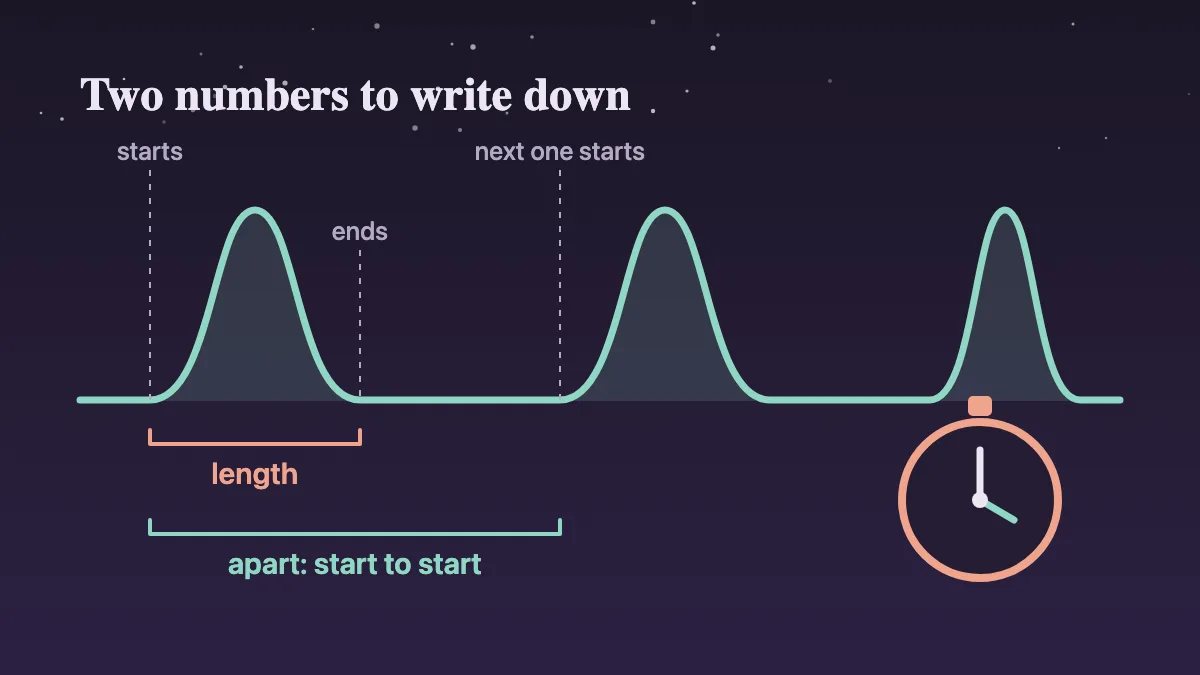
How to time contractions
The two numbers to write down, a worked example, and the mistakes that skew a log.
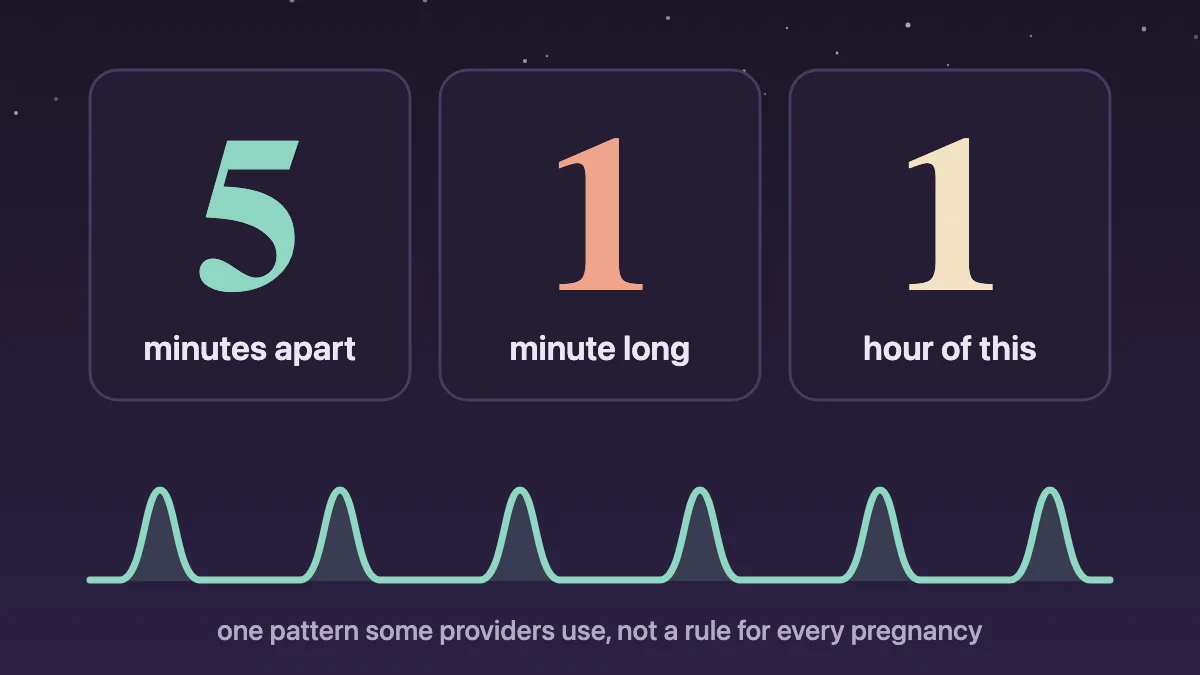
What the 5-1-1 pattern means, and its limits
Five minutes apart, one minute long, for one hour: what that is for, and what it leaves out.
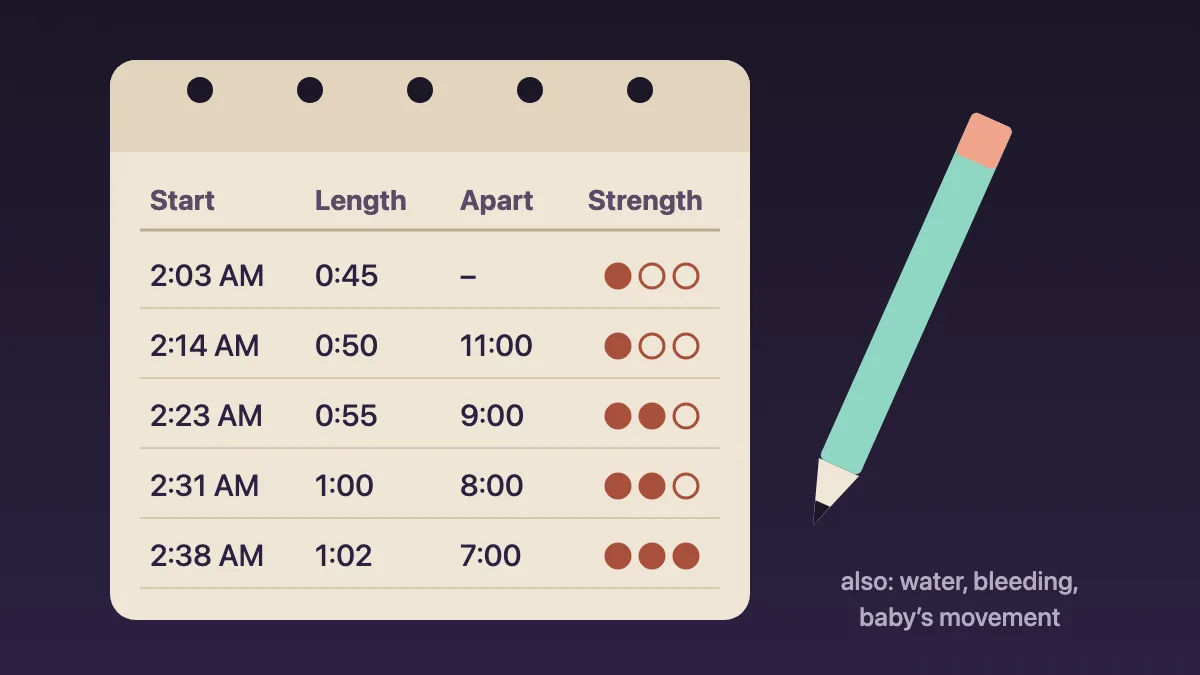
What to note down for your provider
The details a labor line usually asks for, and a short script to read from when you call.

A partner’s guide to timing contractions
How to keep the log so the person in labor does not have to, and what else to have ready.
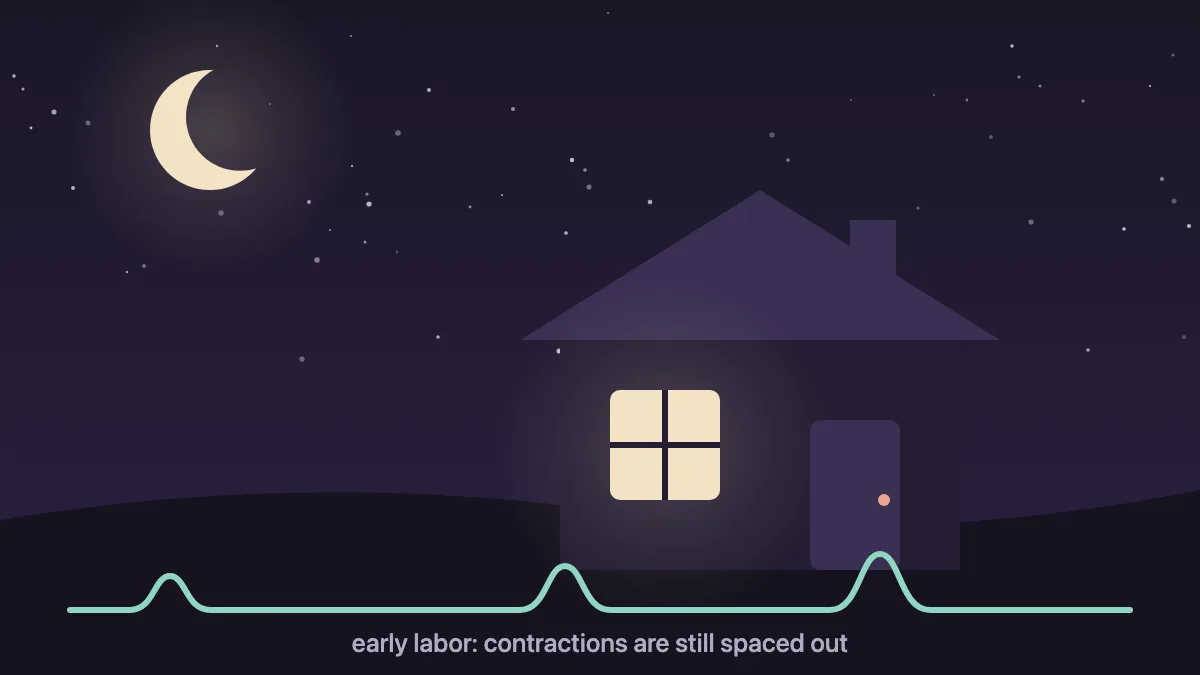
Early labor at home, in the words of the sources
How long it lasts, what helps, and what each source says should prompt a call.