Early labor at home, in the words of the sources
Most people spend the first part of labor at home. The main patient sources agree on that much, and differ on the numbers. Here is what each one says, side by side.
Early labor (the NHS calls it the latent phase) is the stretch before labor is established. The cervix softens, thins and starts to open, and contractions come and go. It is usually the longest part of labor, and for many people it happens at home. This page sets out what the main patient sources say about it, so you can see where they agree and where they differ. Your provider’s instructions come first.
What happens in early labor
Mayo Clinic describes early labor, which it also calls latent labor, as the phase in which the cervix opens less than 6 centimeters while it softens, shortens and thins. Contractions tend to be mild, it says, and may not happen consistently. You may see a clear, pink or slightly bloody discharge, which is likely the mucus plug.
The NHS says contractions may be irregular, with no set pattern to how many you get or how long they last, and can range from slightly uncomfortable to more painful. Cleveland Clinic also puts the end of early labor at about 6 centimeters.
How long it lasts and how the contractions look
Here the numbers differ, a reminder that no single figure describes everyone.
| Source | How long early labor lasts | Contractions in early labor |
|---|---|---|
| NHS | Can take many hours, or even days, before labor is established | Irregular, with no set pattern |
| Mayo Clinic | Not predictable, may stop and start; from hours to days, often shorter if you have had a baby before | Mild, may not be consistent |
| March of Dimes | About 6 to 12 hours for most first-time moms | Mild, every 5 to 15 minutes, lasting 60 to 90 seconds |
| Cleveland Clinic, stages of labor | Typically 6 to 12 hours | Not given on that page |
| Cleveland Clinic, contractions | Not given on that page | May last 20 to 30 seconds and come every 30 to 60 minutes |
So a log from early labor may look untidy, with wandering gaps and lengths that vary. What the sources describe changing as labor moves on is the direction: stronger, longer and closer together. The contraction timer keeps the rows so you can see that direction, and how to time contractions explains how to read them.
Staying at home
Several sources expect you to be at home for this part, if your pregnancy is going normally:
- The NHS says you will probably be advised to stay at home during the latent phase, and that if you go in, you may be sent back home.
- Mayo Clinic says that if your pregnancy is not high risk you may spend most of early labor at home. It adds: talk to your healthcare professional about when to leave.
- March of Dimes says you can spend this time at home or wherever you are most comfortable.
- Cleveland Clinic says your provider will likely tell you that you can be at home for early labor, but that you should be ready to go. Its contractions page says to ask your provider up to what point you can manage at home, and that if you are several weeks from your due date it is always best to call.
What the sources suggest doing
Rest, especially at night
The NHS says that if labor starts at night you should try to stay comfortable and relaxed, and sleep if you can. Cleveland Clinic says it is generally OK to sleep and rest during early labor if you are able to, though contractions may make that hard. March of Dimes lists resting as much as you can. That is a reason not to time every contraction for hours: a run of timings now and then gives you a picture and leaves room for rest.
Gentle activity in the day
If labor starts during the day, the NHS suggests staying upright and gently active, which it says helps the baby move down into the pelvis. March of Dimes and Mayo Clinic both suggest a walk and changing positions.
Eat and drink
The NHS says it is a good idea to eat and drink in the latent stage, because you will need energy once labor is established.
Comfort
Between them, the sources mention a warm bath or shower (Cleveland Clinic says warm, not hot), breathing and relaxation exercises, massage, relaxing music, a birthing ball, gentle stretches and meditation. The NHS adds that a birth partner can help with breathing and rub your back; see the partner’s guide. March of Dimes also lists making sure you are ready to go to the hospital.
What the sources say should prompt a call
Being at home in early labor does not mean waiting out everything. Each source names signs that need a call or a visit straight away.
Water and bleeding. Mayo Clinic says to contact your healthcare professional right away if your water breaks or you have a lot of vaginal bleeding. March of Dimes says to call your provider right away if you have heavy bleeding or bleeding like your period.
ACOG’s list. Go to the hospital if your water has broken and you are not having contractions, you are bleeding heavily, you have constant, severe pain with no relief between contractions, or the baby is moving less often.
The NHS’s urgent list. Waters breaking, vaginal bleeding, the baby moving less than usual, being less than 37 weeks pregnant and thinking you might be in labor, any contraction lasting longer than 2 minutes, or 6 or more contractions every 10 minutes. The NHS says not to wait until the next day for these, even in the middle of the night.
Cleveland Clinic’s list. Its article on signs of labor says to seek care right away for chest pain, dizziness or fainting, severe nausea and vomiting, shortness of breath, swelling in the face, legs or arms, heavy bleeding, or a significant decrease in the baby’s movements.
And the simplest rule, shared by all of them in some form: if you think you are in labor, or you are not sure, call. ACOG says exactly that.
Moving on from early labor
The sources describe active labor as the point when contractions become stronger, longer and closer together, and Mayo Clinic, Cleveland Clinic and March of Dimes all expect you to be at the hospital or birth center by then. When that is for you is the question to put to your provider before the day. What to note down for your provider lists what they are likely to ask when you call.
This page reports what the linked sources say about early labor in general. It is not a plan for your labor and it does not tell you when to leave home. Follow the instructions your own provider gave you, and call your provider or emergency services if you are worried.
Sources
- Mayo Clinic. Stages of labor and birth: Baby, it’s time! (July 23, 2024). Opened November 21, 2026.
- NHS. The stages of labour and birth (page last reviewed 2 May 2023). Opened November 21, 2026.
- Cleveland Clinic. Stages of Labor (last updated April 23, 2025). Opened November 21, 2026.
- March of Dimes. Stages of labor (last reviewed March 2019). Opened November 21, 2026.
- Cleveland Clinic. Contractions (last updated August 8, 2024). Opened November 21, 2026.
- NHS. Signs that labour has begun (page last reviewed 9 November 2023). Opened November 21, 2026.
- ACOG (American College of Obstetricians and Gynecologists). How to Tell When Labor Begins (last reviewed November 2025). Opened November 21, 2026.
- Cleveland Clinic Health Essentials. 10 Signs Labor May Be Beginning (April 25, 2024). Opened November 21, 2026.
Read next
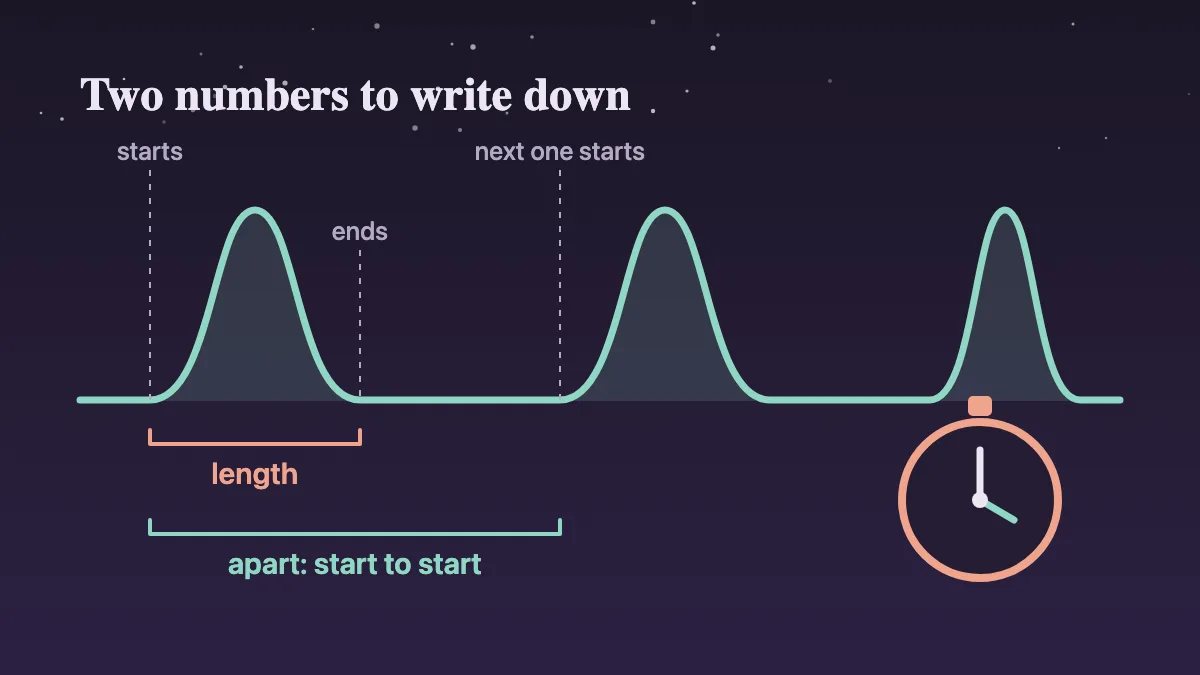
How to time contractions
The two numbers to write down, a worked example, and the mistakes that skew a log.
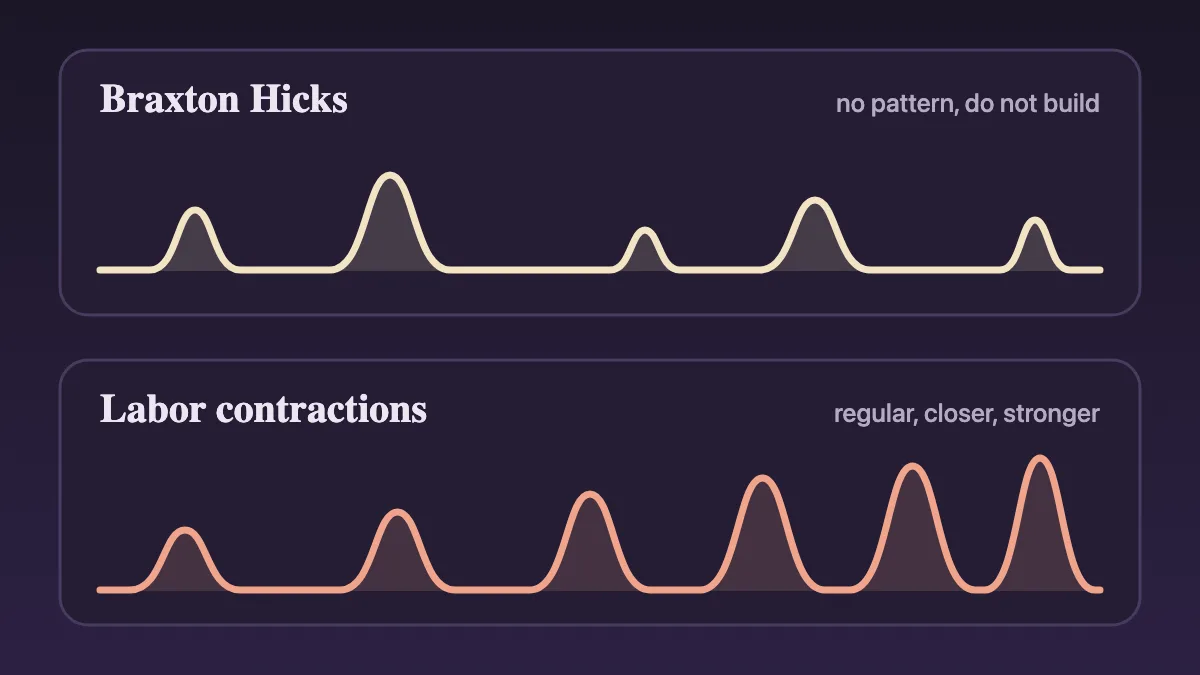
Braxton Hicks or labor contractions?
Five questions the main sources use to tell them apart, and the cases where a log cannot.
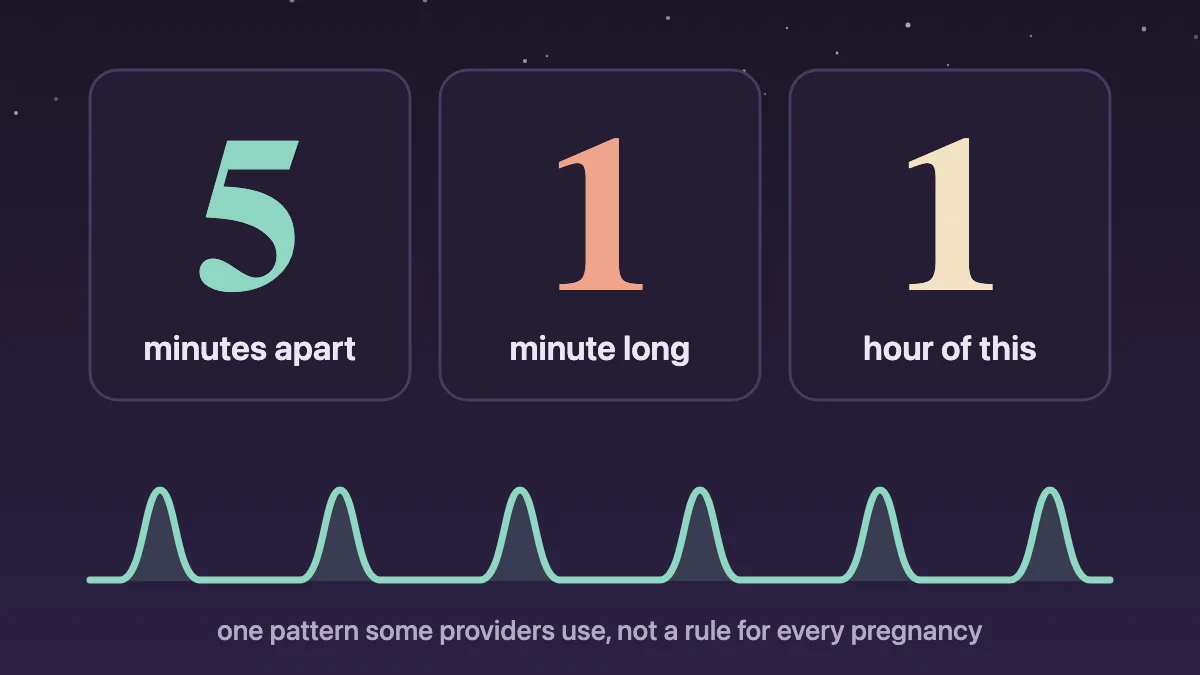
What the 5-1-1 pattern means, and its limits
Five minutes apart, one minute long, for one hour: what that is for, and what it leaves out.
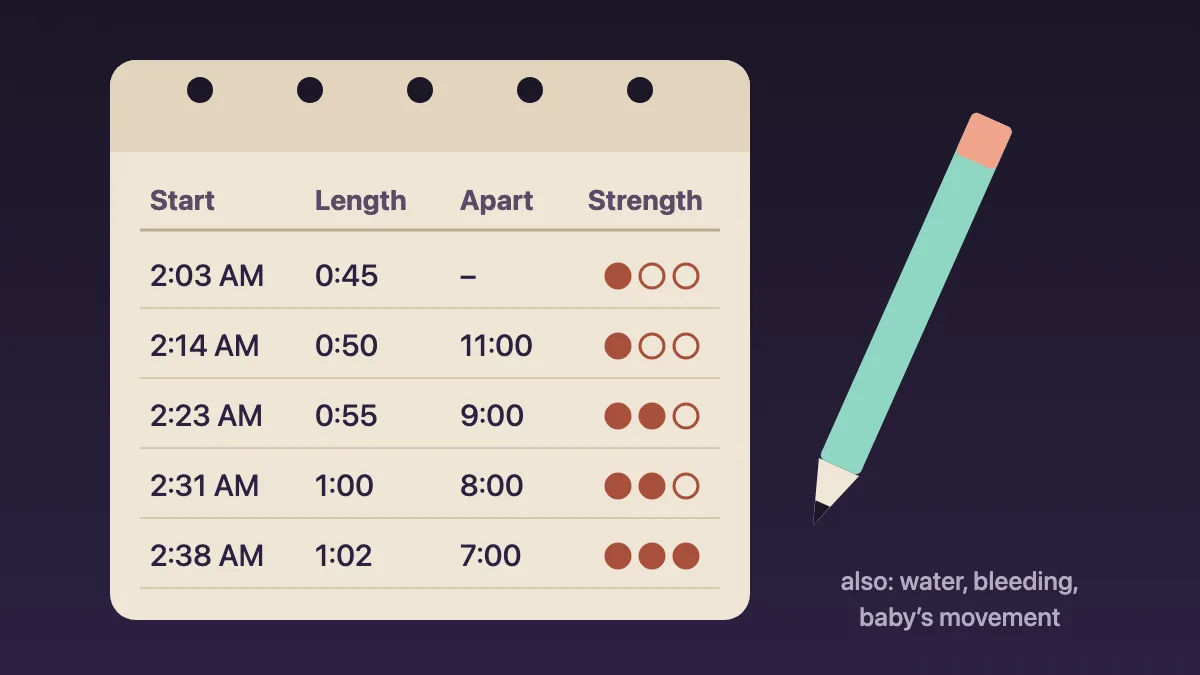
What to note down for your provider
The details a labor line usually asks for, and a short script to read from when you call.

A partner’s guide to timing contractions
How to keep the log so the person in labor does not have to, and what else to have ready.